The seven process categories
📍 Where we are: Part 1 · How It Works — Chapter 4 of 11. Chapter 3 traced the digital steps that are common to every job. Now we open the machine room: the standard sorts all AM machines into seven families by how they join material.
Imagine seven different ways to build a wall. You could squeeze a line of toothpaste-like mortar from a tube. You could bathe a tank of liquid that hardens wherever light touches it. You could spread sand and melt chosen spots. You could spray tiny drops of paint-like material that harden. You could spread sand and spray glue. You could melt metal rod as you place it. Or you could glue down big sheets one on top of another. Those are the seven families: material extrusion, vat photopolymerization, powder bed fusion, material jetting, binder jetting, directed energy deposition and sheet lamination.
What this chapter covers
The international standard ISO/ASTM 52900 groups every additive manufacturing (AM) process into seven process categories, based on how material is joined [1]. We give each one a plain-language definition, a mental picture, the kind of starting material it takes, and a famous example, then compare them in one table. The details of the physics are left for Book 2.
Two vocabulary words first. Feedstock is the raw material fed into a machine, such as plastic filament, liquid resin or metal powder. A powder bed is a flat layer of loose powder that the machine spreads and then selectively joins.
Why categories at all?
In the early years every company used its own names, often trademarks, such as SLA, SLS and FDM (Chapter 2). The standard says there were "numerous different terms and definitions in use, often with reference to specific application areas and trademarks", which was "ambiguous and confusing" [1]. An earlier ASTM terminology standard, F2792, already defined the same seven categories; ASTM lists it as withdrawn in 2015, after the joint ISO/ASTM vocabulary replaced it [2]. Today the seven names are the common language. The 2021 edition of ISO/ASTM 52900 also added three-letter abbreviations for them [1].
The seven, one by one
Each definition below is a close paraphrase of the standard's text [1].
1. Material extrusion (MEX)
Material is selectively dispensed through a nozzle or orifice. The mental picture is a hot-glue gun, or a cake decorator squeezing icing, moving over a flat surface. Most desktop 3D printers work this way, usually melting a thermoplastic filament (a plastic that softens when heated). The trademarked name for the idea is FDM; its patent was filed by S. Scott Crump of Stratasys in 1989 [3]. Because the defining feature is a nozzle or orifice, material extrusion is not limited to plastic: it can also dispense pastes, such as cement-based mixtures and gel-like bio-inks (Chapter 5).
2. Vat photopolymerization (VPP)
Liquid photopolymer in a vat is selectively cured by light-activated polymerization. A vat is simply a tank, and polymerization is the chemical reaction in which small molecules link into long chains and the liquid turns solid. Picture a bath of clear liquid that turns to plastic only where a laser or projected image shines on it. Hull's stereolithography (1984 patent filing) is the original example [4]. The part is typically lifted out of the liquid and washed.
3. Powder bed fusion (PBF)
Thermal energy selectively fuses regions of a powder bed. Picture a tray of fine sand across which a laser draws a shape, melting the grains together only along the lines it travels. A roller or blade then spreads a fresh thin layer of powder and the cycle repeats. In many systems the unfused powder around the part helps hold it in place, and is brushed away afterwards. Examples include selective laser sintering (Deckard's patent, filed 1986) [5], laser melting of metal (Fraunhofer ILT, 1990s) [6] and electron beam melting (Arcam) [7]. It takes both plastic and metal powders.
4. Material jetting (MJT)
Droplets of feedstock material are selectively deposited. The standard's example feedstocks are photopolymer resin and wax [1]. Picture an ordinary inkjet paper printer, but each pass leaves a thin layer of solid material instead of ink, so many passes build a part. Some machines can place different materials in different spots, which allows multi-color or multi-material models.
5. Binder jetting (BJT)
A liquid bonding agent is selectively deposited to join powder materials. Picture the same powder bed as in PBF, but instead of heat, an inkjet-style head sprays glue where the part should be. The MIT patent of Sachs and colleagues (priority 1989) describes exactly this: spread powder, selectively print a binder, repeat, then remove the unbound powder [8]. The glued part is fragile ("green") and often needs further treatment, such as heating, to become strong. A binder jetting machine needs no laser; the MIT patent mentions ceramic, metal and plastic powders.
6. Directed energy deposition (DED)
Focused thermal energy is used to fuse materials by melting as they are being deposited. The standard explains that the energy source can be a laser, an electron beam or a plasma arc [1]. Picture a welder who lays down weld metal in a path to build up a shape, except guided by a computer. The material is typically metal fed into the beam as a wire or a stream of powder. Because DED adds material to a surface, the standard notes the surface can be an existing part, so DED is also used to repair worn parts [1].
7. Sheet lamination (SHL)
Sheets of material are bonded to form a part. Picture cutting layers out of paper, metal foil or plastic film and gluing, welding or otherwise bonding them into a stack. In laminated object manufacturing (LOM), sheets are cut to the outline of each layer and the layers are stacked and bonded in sequence; a patent by Michael Feygin, filed in 1987 and later assigned to Helisys, describes this approach [9]. In ultrasonic additive manufacturing, material layers are consolidated with ultrasonic vibration and pressure, as in a Solidica patent with a 2000 priority date [10].
Comparison at a glance
| Category | Abbrev. | How material is joined | Typical feedstock | Mental picture |
|---|---|---|---|---|
| Material extrusion | MEX | Squeezed through a nozzle, then solidifies | Plastic filament, pastes | Hot-glue gun |
| Vat photopolymerization | VPP | Light cures liquid resin | Liquid photopolymer | Bath that hardens under light |
| Powder bed fusion | PBF | Heat fuses regions of a powder bed | Plastic or metal powder | Laser tracing in sand |
| Material jetting | MJT | Droplets deposited, then solidify | Photopolymer resin, wax | Inkjet printer that builds up |
| Binder jetting | BJT | Liquid binder glues powder | Powder plus liquid binder | Glue sprayed onto sand |
| Directed energy deposition | DED | Focused energy melts material as it is placed | Metal wire or powder | Computer-guided welder |
| Sheet lamination | SHL | Sheets are bonded | Sheets of paper, foil or film | Stack of cut and glued sheets |
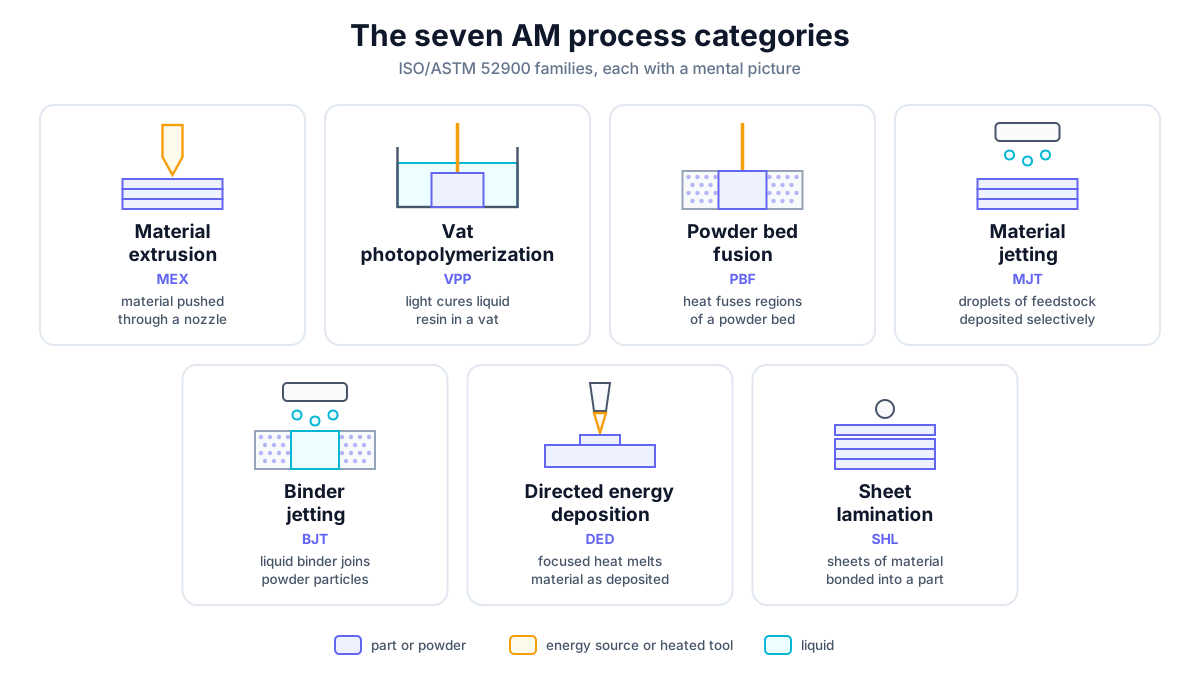 The seven ISO/ASTM 52900 process categories, each with a small picture: nozzle, light and vat, laser and powder bed, droplets, binder on powder, focused energy with a feed nozzle, and stacked sheets.
Original diagram by the authors, created with AI assistance.
Why it matters
A category tells you most of what you need to know about a machine before looking at its brand. It hints at which materials it can process, how fine its detail is, whether parts need supports, how much finishing they need and what it will cost. For example, a powder bed process needs a way to remove loose powder, and a vat process needs washing of liquid resin. When someone says "I have a 3D printer", the first useful question is "which of the seven?"
In the real world
You are most likely to meet material extrusion (hobby and school printers), vat photopolymerization (finely detailed models) and powder bed fusion (plastic and metal parts). Directed energy deposition can add metal to an existing part, which suits repair work. Material jetting, binder jetting and sheet lamination appear in more specialized settings. The research literature describes each family as having typical strengths and trade-offs, which Book 2 covers in depth, one chapter per family or group [11], [12], [13].
Key terms
- Process category — one of the seven families in ISO/ASTM 52900 that group AM methods by how material is joined.
- Feedstock — the raw material fed into an AM machine.
- Powder bed — a flat layer of loose powder that is spread and then selectively joined.
- Vat — a tank holding liquid resin in vat photopolymerization.
- Photopolymer — a liquid plastic that hardens when exposed to light.
- Polymerization — a chemical reaction in which small molecules link into long chains, turning a liquid into a solid.
- Binder — a liquid glue sprayed onto powder to hold particles together.
- Directed energy deposition (DED) — a process where focused heat melts material as it is deposited.
- Sheet lamination — a process in which sheets of material are bonded layer on layer to form a part.
- Green part — a fragile part held together only by binder, before it is strengthened by further treatment.
Where this leads
Every category depends on the material it joins. Next: Materials at a glance.